Friday, September 21, 2012

HELP!


While walking through one of my favorite antique stores not too long ago, I came across something that I fell in love with.  But what the heck is it?


In all my years of rummaging through antique malls, flea markets, and even swap meets, I have never seen anything quite like this.  The top looks to me like it could possibly be part of a lamp or even a trophy, but take a look at the stem near the base of it.


As you can see, it’s not a toggle switch to turn something on or off.  What throws me off is that it unscrews from the main portion of the piece.


The other thing that really throws me for a loop is the bottom of the base itself.  To me, it looks like a spout that could dispense some kind of beverage.


So, I need some help identifying this absolutely fabulous, almost one-of-a-kind, wonderful… thing.  Any help will be greatly appreciated on figuring this one out.

If it’s any help, here are some pictures of the marks on the bottom of the piece.  The person with the best answer will get a coupon code to get 20% off an item in my TIAS store.

The store can be seen here.


Monday, September 17, 2012

Condition, Condition, Condition!

It’s definitely the first three rules of the antiques and collectibles world.  It could probably be stretched out to be rules 4 and 5 as well with not much effort.
 

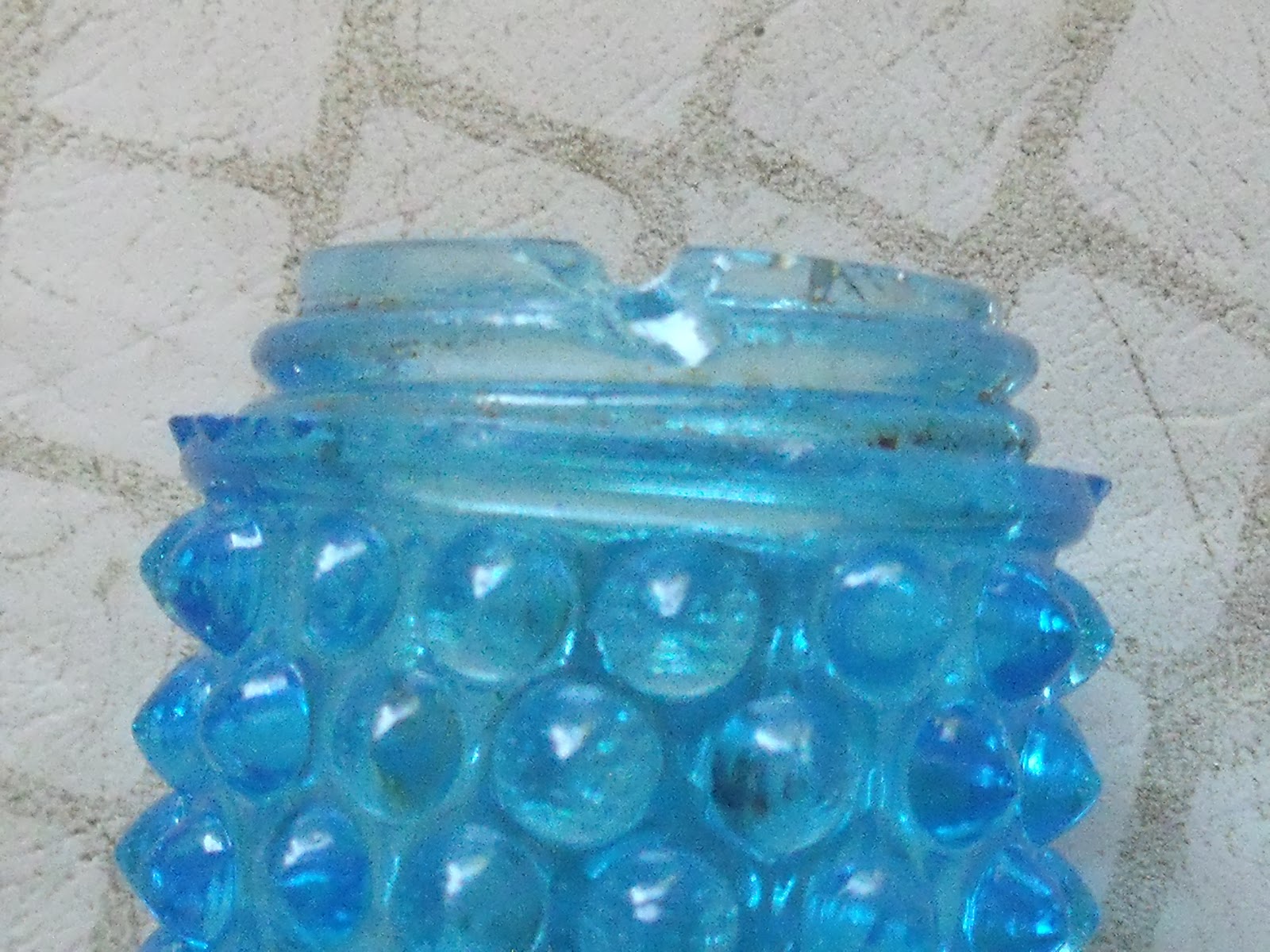
Here’s a quick question:  can you tell me what’s wrong with the shaker in the picture above?


I hate to say it, but it has a nasty chip underneath the lid.  The chip is just way too big to buff out.

I saw an article many years ago that stated that when there is damage to a piece of glassware like a chip or a crack, it’s only worth 20 percent of its original value.


Keeping that in mind, you need to check the item out very thoroughly before you commit to buy.  This was one of the first lessons that I learned when I first started out.  Check for chips on the edges and underneath a lid, and even look through the item to see if you can find any cracks.  If it has an applied handle, check to see if there are any cracks where the handle and the body of the item meet.

 
If you happen to get home and find some damage, don’t fret.  You can repurpose the item into a make shift vase, or something else completely (like a pencil holder).

Thursday, September 13, 2012

It’s Time For Kickoff!

I can see it now.  The Tailgate party is in full swing, and there are plenty of Bratwursts on the grill.

The football season is now going strong, and you need something to take your goodies to the tailgate party, but you don’t know what to take.  I’ve got the perfect idea:


What a great way to take some of those goodies than with a 1950’s lunch pail.  This sucker has tons of college banners on it, from Harvard to Yale.
 
To look at the lunch pail, you can go to my TIAS store here.

Monday, September 10, 2012

Searching The World Wide Web

With a book out on the market on just about any antiques and collectibles area that you could imagine, it would be a safe bet that you could find any item fairly fast, right?
 
Sometimes it doesn’t work out that way.  The internet can be a great resource for information on the item that you’re looking for, like a head vase for example.


When I look for something, I start with a fairly broad search by typing in “head vase”.  If that doesn’t get me what I need, this is when I start typing in specifics.  If the piece has a stamp or a sticker with the makers name on it, I use that.


With you narrowing down the search, you get to the point where you can find the item you have pretty quickly.  It could get to the point where you can find several listings of the same item as yours so that you have a great price range.

Friday, September 7, 2012

Store Highlight: Rolling Stone Cover


Sometimes, the description you put next to an item for sale just doesn’t do it justice.  Sometimes, you post an item in your online store that’s so cool, you’ve got to write a blog post about it. 

That’s what happened with my Rolling Stone cover:


Why is this old mag so cool, you might ask?

·         It appeals to Beatles collectors.
·         It appeals to pop culture collectors.
·         It features fun, remember-when ads.
·         It highlights the fashion of the ‘70s.
·         It offers reviews of all the “hot” albums of the time.
·         It allows anyone who grew up in the ‘70s to walk down memory lane.

The Rolling Stones magazine is up for sale in my TIAS store, which can be seen here.

Monday, September 3, 2012

How Do You Bid?


You have your bidder’s number, and you have looked at all of the items at the auction.  What’s next?

At the beginning of every auction, the auctioneer will tell you what is going to go on throughout the auction.  They’ll tell you which items will sell first, and if they will auction the house off.  They’ll also say some other general announcements pertaining to the sale (like if they are selling off the furniture at a certain time).

The next thing to do is to wait for the items you want to bid on.  While you are listening to what’s going on at the auction, this is a great time to figure out what you would like to spend on what you saw before the start of the sale.  You also need to keep an eye on what they are selling as well.  I don’t know how many times I have bid on an item that is selling way too cheap.

This is also a great time to size up the competition.  What I do is to listen for a buyer’s number that is being repeated over and over again.  I will try to grab a peek at the person who is attached to the bidder’s number to see who it is.  After you attend a few auctions, you also notice the same faces showing up as well.   Be courteous and friendly to other bidders, especially your main competitors.  If they are behind you, or a little farther away from the auction than you, hand them the item that they just bought.  I also give people room for the items that they buy as well.  If you are a courteous bidder, most of the time the other auction-goers will be this way with you.

If a cheap item happens to come up for sale while I am waiting for the items that I really want to bid on, I will place a bid on it to let the auctioneer know that I am here to buy, not just to watch.  When you bid, you are introducing yourself to the auctioneer and the other bidders.  Don’t drive up bids to back out consistently.  Again, be courteous; others will extend the favor to you as well.

When you think about it, bidding for the first time buyer can be one of the scariest things to do.  It doesn’t matter if it’s a $200 Fenton Gone with the Wind Lamp, or a $2 toy.  I was nine years old when I bid for the first time.  Bidding for my mother, I learned a few things that I need to do so that I can be a successful bidder.

First, I learned not to jump in right away.  Auctioneers always try to set the price of the item high.  When they don’t get a bid, they will keep lowering the price until someone jumps all over it. 

I also learned that when bidding for the first time, you sometimes have to work to get the auctioneer’s attention.  Waive your arm, your bidder’s number, or shout “Yeah,” “Yes,” or even “Over here.” 
There are quite a few ways to bid.  It ultimately comes down to what your personal preference is.  Mine is to stick my arm up in the air so that the auctioneer can see me.

Once you are noticed, you can even nod your head.  If you are standing behind the auctioneer or one of their employees that hold up item for sale, you could poke them in the back.

Raising an eyebrow, wagging a finger, or even raising your pen in the air are also great ways to bid once you are on the auctioneer’s radar.

If you are new to the world of bidding, experiment with what works for you.  You will come up with a great way that is perfect for you.

Happy bidding!